
/

/

Sydney Gateway Stormwater

Sydney Gateway Stormwater

Web Developer

|

November 26, 2026

Client

JHSW JV (John Holland / Seymour Whyte)

Location

St Peters and Mascot, Sydney NSW

Value

$4.1 million

Completed

March 2023

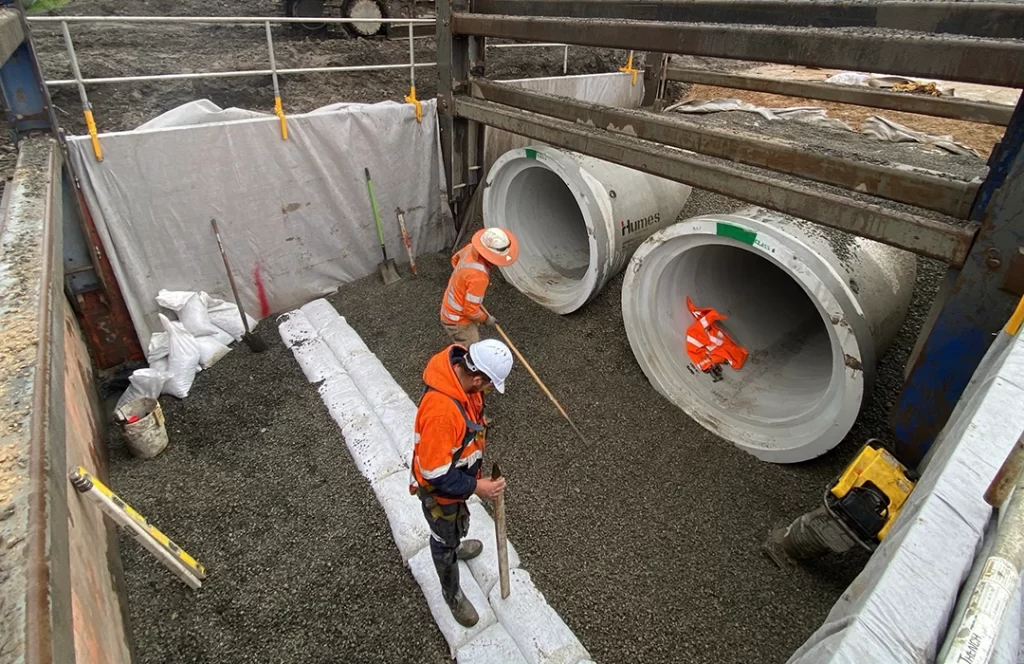
Three construction workers install large concrete pipes in a trench, surrounded by gravel, tools, safety barriers, and sacks.Three construction workers install large concrete pipes in a trench, surrounded by gravel, tools, safety barriers, and sacks.
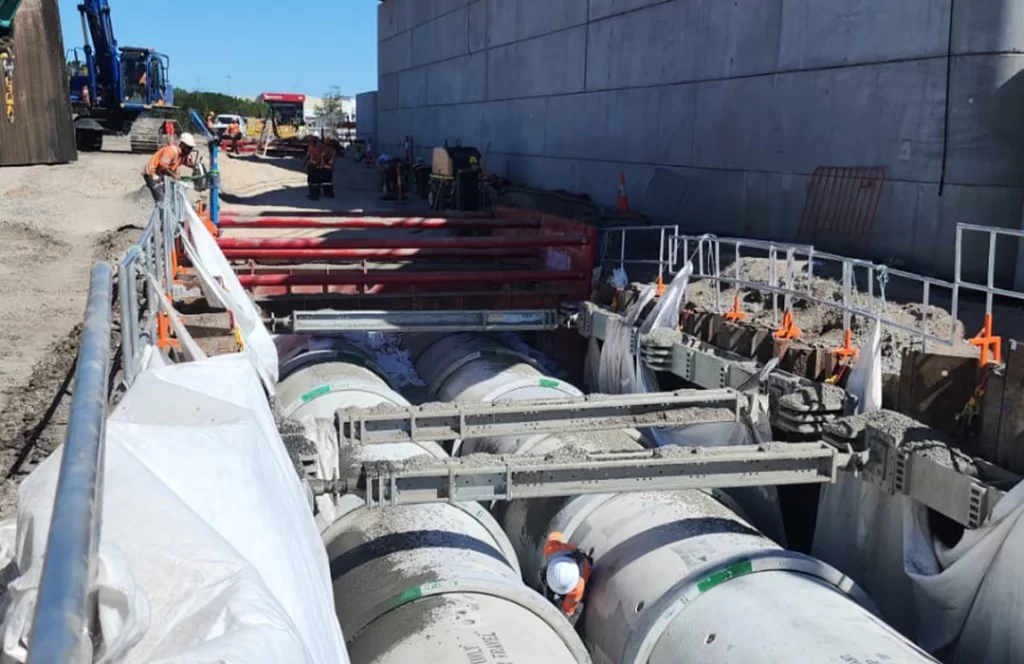
Construction workers install large concrete pipes in a trench beside a concrete wall, with machinery and safety barriers present at the site.Construction workers install large concrete pipes in a trench beside a concrete wall, with machinery and safety barriers present at the site.
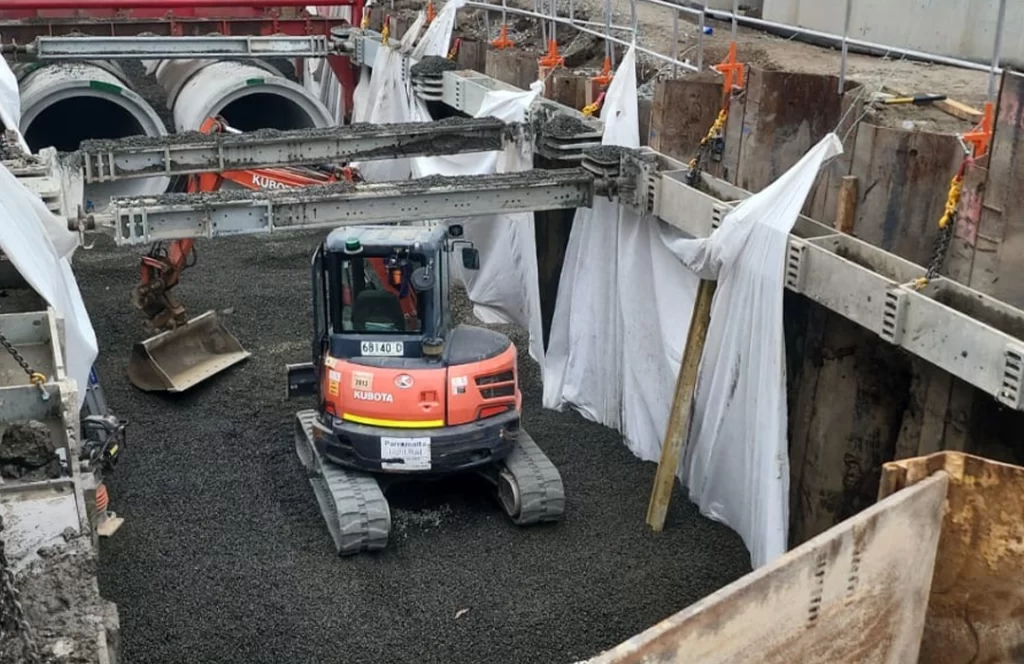
A small excavator operates in a trench lined with white sheets and gravel, with construction equipment and large concrete pipes visible in the background.A small excavator operates in a trench lined with white sheets and gravel, with construction equipment and large concrete pipes visible in the background.
Three large concrete drainage pipes are installed in a construction site wall, surrounded by sandbags and forming part of a foundation structure.Three large concrete drainage pipes are installed in a construction site wall, surrounded by sandbags and forming part of a foundation structure.
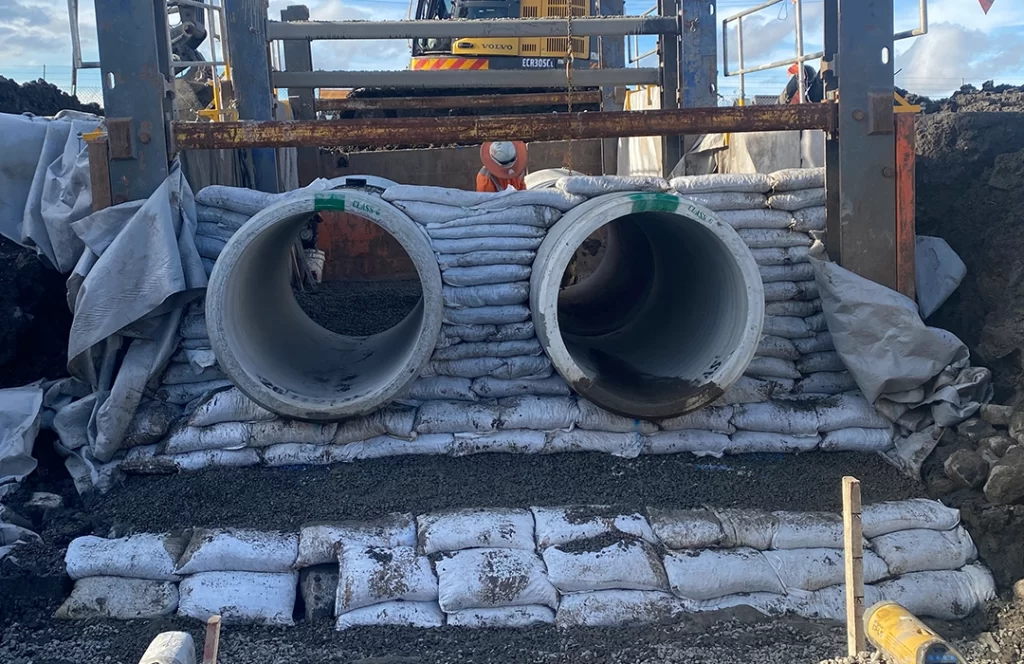
Two large concrete pipes are installed side by side, supported by stacked sandbags, with construction equipment and a worker visible in the background.Two large concrete pipes are installed side by side, supported by stacked sandbags, with construction equipment and a worker visible in the background.
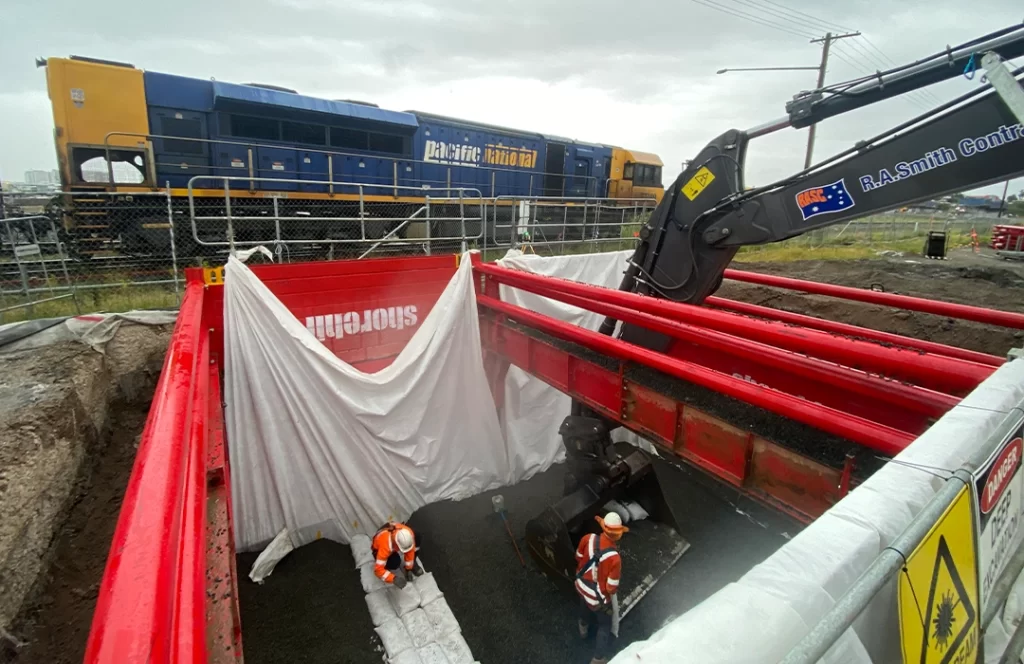
Two construction workers work inside a shored trench while an excavator operates above ground; a freight train passes by in the background behind a safety fence.Two construction workers work inside a shored trench while an excavator operates above ground; a freight train passes by in the background behind a safety fence.
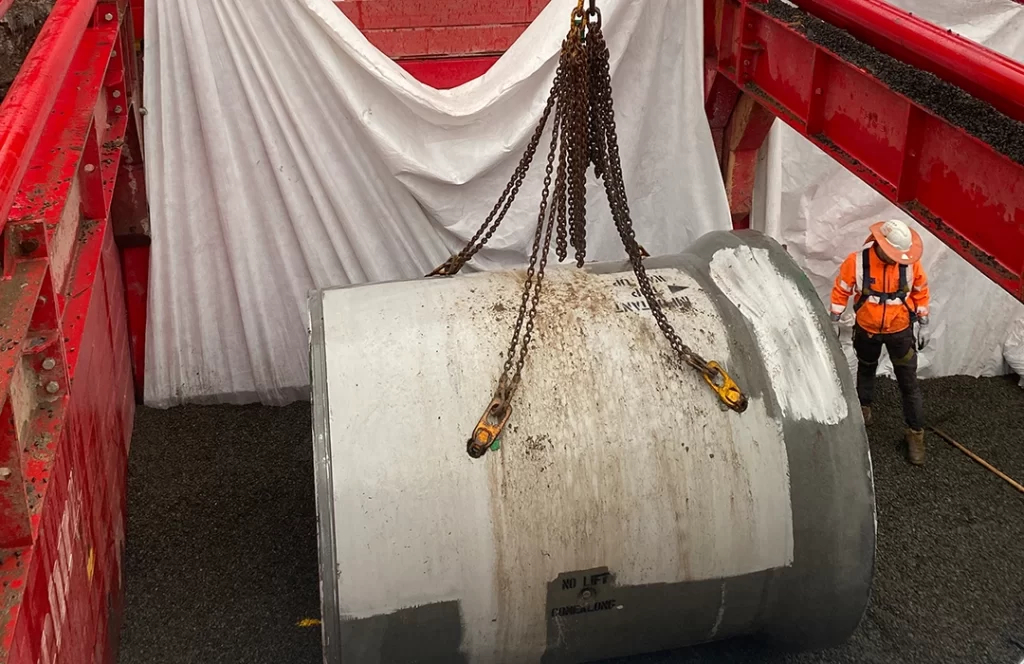
A large concrete pipe is lifted by chains from a crane, while a worker in high-visibility gear and a hard hat stands nearby on gravel inside a construction area.A large concrete pipe is lifted by chains from a crane, while a worker in high-visibility gear and a hard hat stands nearby on gravel inside a construction area.
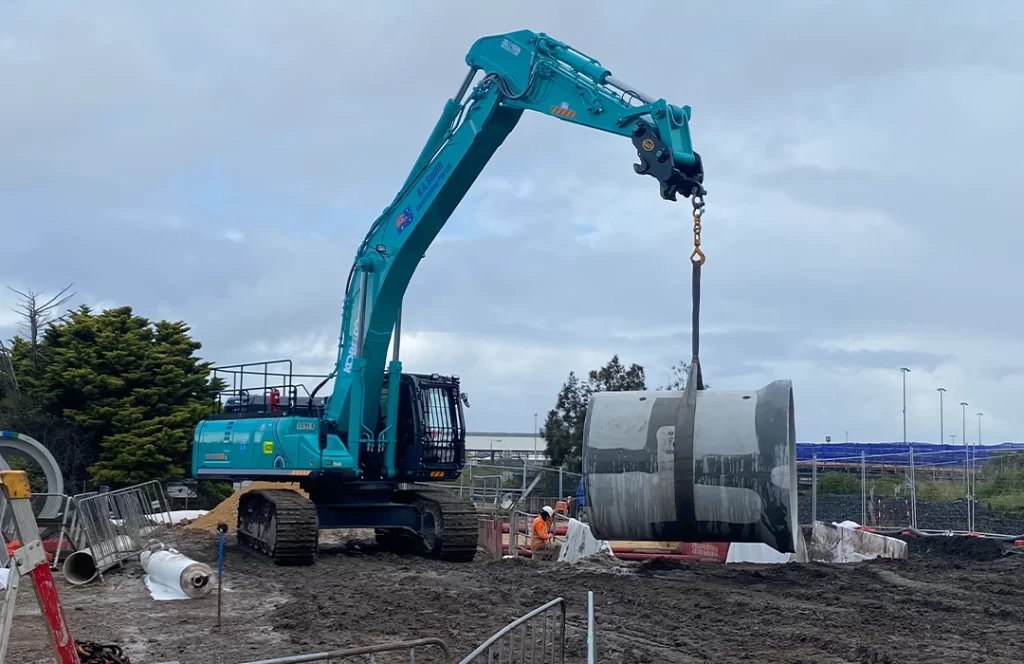
A teal excavator lifts a large concrete pipe at a muddy construction site, with workers and fencing visible in the background under a cloudy sky.A teal excavator lifts a large concrete pipe at a muddy construction site, with workers and fencing visible in the background under a cloudy sky.
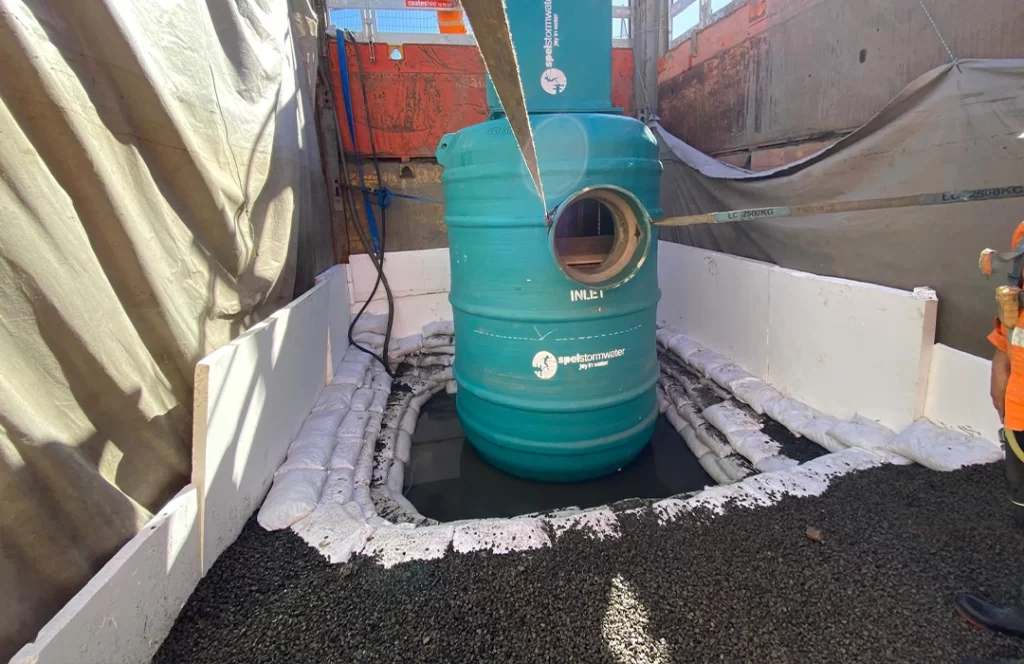
A large blue cylindrical tank labeled "inlet" is installed in a construction pit, surrounded by sandbags and gravel, with workers and barriers nearby.A large blue cylindrical tank labeled "inlet" is installed in a construction pit, surrounded by sandbags and gravel, with workers and barriers nearby.
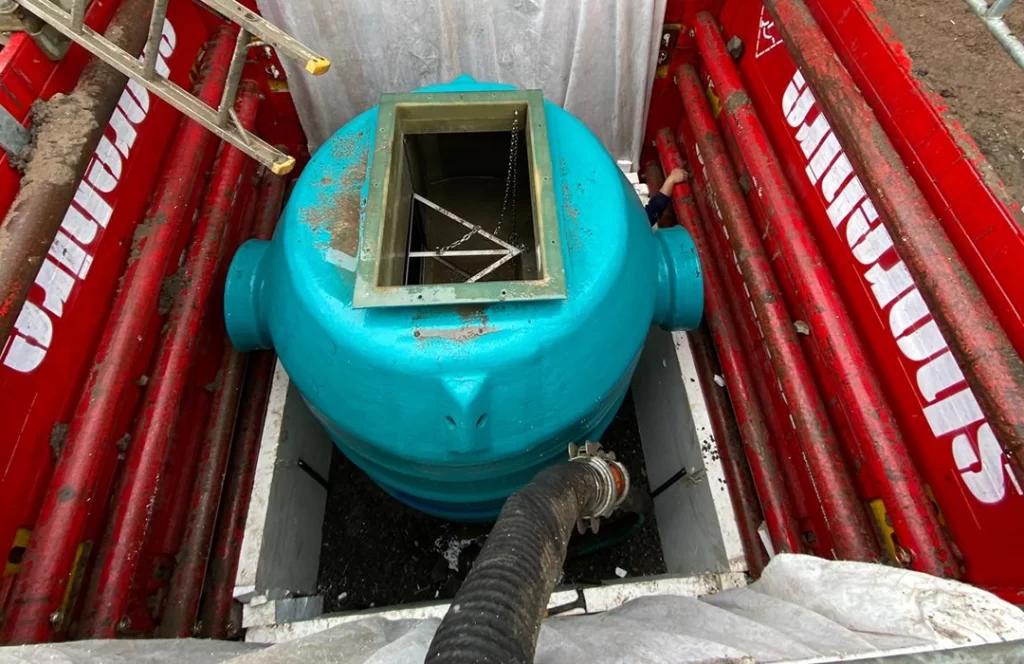
A blue cylindrical tank with a square open top is positioned in a red metal enclosure, with a black hose connected to its side.A blue cylindrical tank with a square open top is positioned in a red metal enclosure, with a black hose connected to its side.
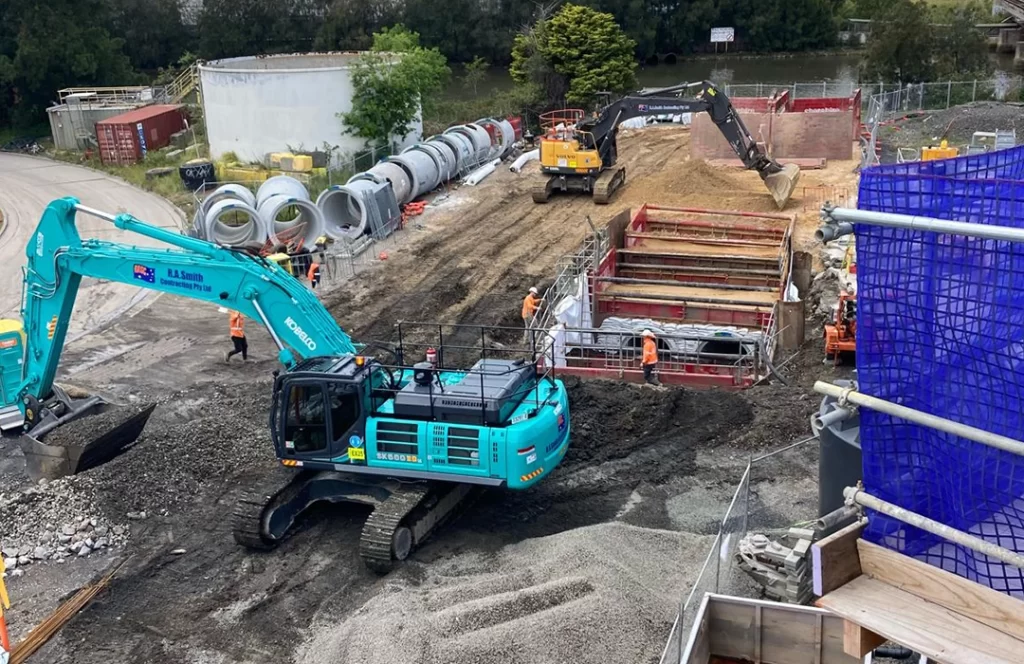
Excavators and workers operate on a construction site with large pipes, containers, and piles of sand and gravel under an overcast sky.Excavators and workers operate on a construction site with large pipes, containers, and piles of sand and gravel under an overcast sky.
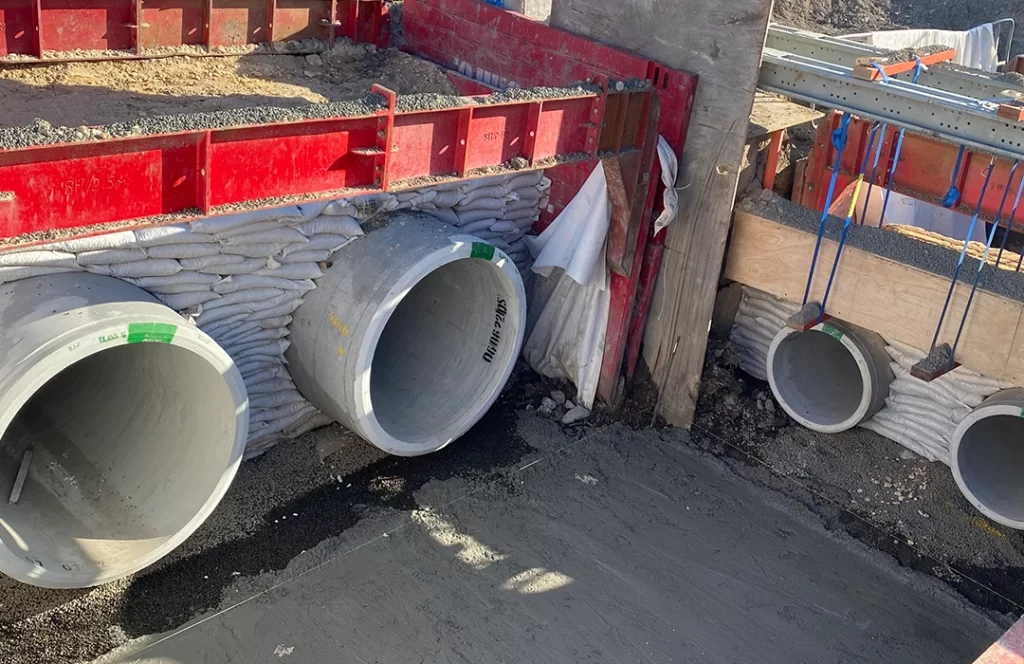
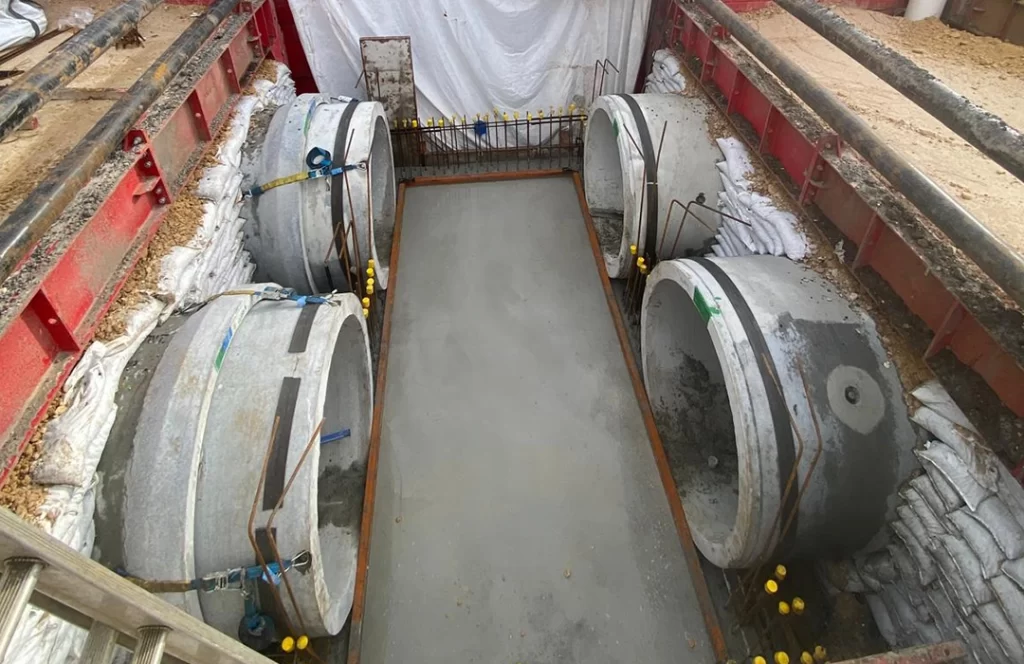
Four large concrete pipe sections are positioned horizontally within a rectangular excavation site lined with sandbags and metal supports.Four large concrete pipe sections are positioned horizontally within a rectangular excavation site lined with sandbags and metal supports.

Project Overview

Sydney Gateway stormwater beside a canal and beneath a rail siding

RA Smith Contracting built stormwater drainage and a discharge structure on the Sydney Gateway stormwater works at St Peters and Mascot. The client was the JHSW JV (John Holland and Seymour Whyte), and the $4.1 million package ran from January 2022 to March 2023. 

The work included a sheet-pile coffer dam in Alexandra Canal and twin DN1500 RCP outlet pipes. It also covered 390m of carrier trench in water-charged ground and twin DN1800 RCP pipes beneath an operational rail siding. Stormwater work like this is part of our stormwater services. 

Most of the work was in wet ground, with parts in a waterway and under rail.

January 2022 to March 2023

The Challenge

Water-charged ground, a canal outlet and a rail possession

The ground was water-charged, and some of it had been pre-stabilised while some had not. Groundwater management was essential, and the excavations were inherently unstable for the people working in them. 

The outlet had to go into Alexandra Canal, a tributary of the Cooks River. That meant working inside a coffer dam, with sediment controls to hold back any discharge of material. 

The twin DN1800 pipes beneath the rail line were planned for a 7-day possession that started at 7:00am on Christmas Day. The work was time-critical, and the detailed planning involved the other contractors.

The Solution

A coffer dam, a bedding mattress and a planned possession

RA Smith used a different method for each condition and planned the possession work in detail. 

Canal outlet. The crew installed a steel sheet-pile coffer dam in the canal and put sediment controls beyond the piles. A spear-type dewatering system managed inflows through the sheet piles. The crew then prepared the canal bed foundation, laid the twin DN1500 RCP pipes and backfilled. Basalt spalls from 100mm to 300mm went in below water level to protect the canal from erosion by the new discharge. 

Carrier trench. The crew used two 4m long by 2.4m high shore boxes, to a full depth of about 3m. TS60 geotextile and basalt spalls formed a bedding mattress that funnelled groundwater beneath the pipe. Two 4 inch trailer-mounted pumps held the water table down after two significant rain events. 

Embedment. The crew compacted 14mm aggregate below and around the pipe, which was wrapped in TS60 geotextile. They then placed and compacted 20mm sandstone backfill over it. 

Rail crossing. Resources were mobilised for the possession window, with the work planned alongside the other contractors.

Project Outcome

Stormwater delivered without incident or delay

RA Smith delivered the Sydney Gateway stormwater packages without incident or delay.

Key Outcomes

  • Twin DN1500 RCP outlet pipes installed in Alexandra Canal behind a sheet-pile coffer dam 
  • 356m of twin DN1500 RCP, 6m of DN1350 RCP and 28m of DN1200 RCP carrier installed in water-charged ground 
  • Three B80 in-situ pits with debris retention barriers, one Spel tank and two precast pits built 
  • Twin DN1800 RCP pipes planned for installation beneath an operational rail siding 
  • Groundwater managed through dewatering and a bedding mattress 
  • Works delivered without incident or delay

The experience from earlier works on the project helped manage the groundwater and the unstable ground. RA Smith has worked on several Sydney Gateway contracts and still provides enabling works there. Our Integrated Management System is third party accredited to AS/NZS ISO 9001:2015, ISO 45001:2018 and ISO 14001:2015.

Technical Scope

What the works involved

Stormwater Outlet Structure

  • Steel sheet-pile coffer dam in Alexandra Canal, a tributary of the Cooks River 
  • Sediment controls beyond the sheet piles 
  • Spear-type dewatering system to manage inflows through the sheet piles 
  • Canal bed foundation prepared with placed and compacted fill 
  • Twin DN1500 RCP pipes to the discharge limit, with backfill 
  • Canal bank backfilled and profiled to match the existing bank, ready for shotcrete erosion protection 
  • 100mm to 300mm basalt spalls placed below water level for erosion protection 

Primary Stormwater Carrier

  • About 390m of excavation in water-charged ground 
  • 356m of twin DN1500 RCP, 6m of single DN1350 RCP and 28m of single DN1200 RCP, at a 0.2% grade 
  • TS60 geotextile and basalt spalls as a bedding mattress, with 14mm aggregate embedment and 20mm sandstone backfill 
  • Three B80 in-situ reinforced concrete pits with debris retention barriers 
  • One Spel tank and two precast pits 

Longitudinal and Transverse Drainage

  • RCP stormwater drainage from twin DN1800 down to DN600 
  • Installation beneath an operational rail siding 
  • Rail possession of 7 days, starting at 7:00am on Christmas Day

FAQs

Sydney Gateway Stormwater FAQs

What did RA Smith build on the Sydney Gateway stormwater works?

RA Smith installed primary stormwater drainage and a discharge structure for the JHSW JV, including twin DN1500 RCP outlet pipes in Alexandra Canal, about 390m of carrier trench in water-charged ground and twin DN1800 RCP pipes beneath an operational rail siding.

How was the stormwater outlet built in Alexandra Canal?

RA Smith installed a steel sheet-pile coffer dam in the canal, with sediment controls beyond the piles and a spear-type dewatering system to manage inflows. The crew then prepared the canal bed, laid the twin DN1500 RCP pipes, backfilled and placed 100mm to 300mm basalt spalls below water level for erosion protection.

How was groundwater managed in the Sydney Gateway carrier trench?

RA Smith used two 4m long by 2.4m high shore boxes for support, laid TS60 geotextile and basalt spalls as a bedding mattress to funnel groundwater beneath the pipe, and ran two 4 inch trailer-mounted pumps after two significant rain events.

How were the twin DN1800 pipes installed beneath the rail siding?

The work was planned for a 7-day rail possession starting at 7:00am on Christmas Day. RA Smith planned it in detail with the other contractors, because the work was time-critical.

How much stormwater pipe is in the Sydney Gateway carrier?

The carrier has 356m of twin DN1500 RCP, 6m of single DN1350 RCP and 28m of single DN1200 RCP, with a 0.2% grade, across about 390m of excavation.

Our Projects